
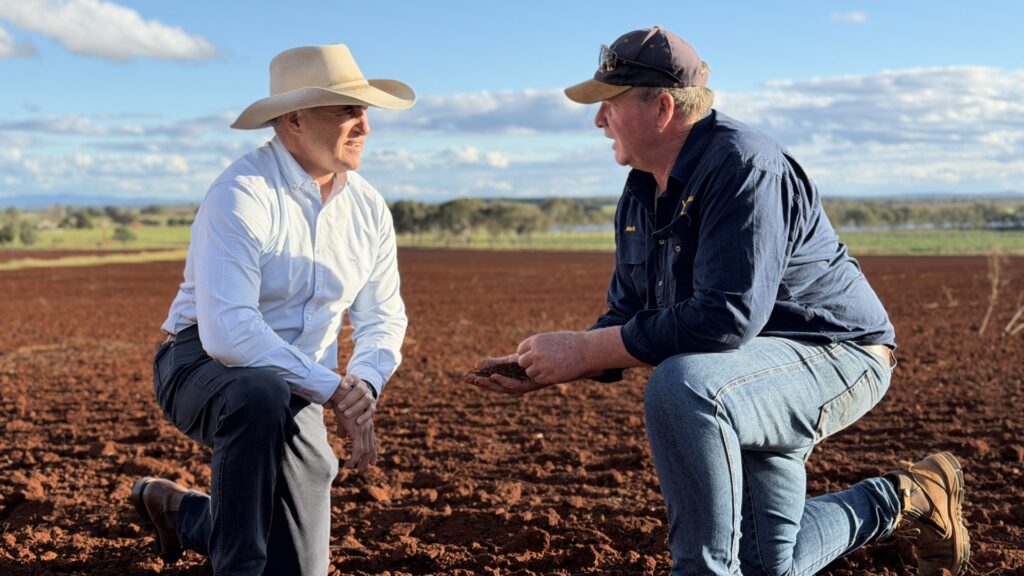
Why are Australian farmers expected to meet some of the world’s toughest regulatory and food safety standards, while lower-cost imports can compete on the same supermarket shelf without being produced under the same standards? The Leader of the KAP and state Member for Traeger Robbie Katter has asked.
The peanut industry, predominantly based around Wide-Bay Burnett and Tablelands districts in Queensland, is at a crossroads, with only one processor left in Australia, and more reports of illegal imported peanuts putting the industry at risk from both disease and inferior quality cheap product.
Mr Katter echoed the calls of KAP Federal Member for Kennedy, calling for the immediate suspension of peanut imports where there is uncertainty about compliance with Australia’s biosecurity requirements, and to release the results of government investigations confirming the germination of imported peanuts (which significantly increases the risk of disease spread).
“If we want to be able to say we grow any food in this country we need to protect our farmers and industry at all costs,” he said.
“Canberra and Brisbane governments need to wake up and prioritise the future of our farming industries over their blinkered pursuit of the ‘free market’.
Analysis by industry advocate and agronomist Judy Plath has revealed 18 detections by the Federal Agriculture Department of peanut products with unacceptable levels of aflatoxin mould between January and April 2026.
“Aflatoxin is a carcinogenic mould that can be found in peanut products, and something that Australian growers work very hard at keeping out of our products,” Ms Plath said.
“As an industry we take pride in our clean products, but the Department’s report reveals other countries don’t have the same standards.”
“Unfortunately, the government is only testing a very small percentage of imported products, so how many toxin-ridden peanut foods are slipping through the net?” Ms Plath asked.
Mr Katter said it was critical that consumers were checking if they were buying Australian or imported products, for confidence in what they were eating, and to support Australian industry and jobs.
“With Australian products you can be confident it’s all up to standard. Overseas? You don’t know what you’re feeding your family. I don’t want any cancer-causing toxins anywhere near my kids’ food,” Mr Katter said.
“I challenge everyone to look at where the products they pick up down the supermarket aisle come from and note the price they are marketed at compared to Australian products – if you can find Australian product at all.
“Coles and Woolies are guilty of pushing cheap imports. It’s a battle to find an Australian product even if you’re looking for them. They need to hang their heads in shame and support hard working Aussie farmers.
“Successive governments have overseen the destruction of our Agriculture industries, and the KAP won’t sit idle and watch the peanut industry become the next tobacco industry, or dairy industry, and watch the human heartache that would sweep through rural communities like Kingaroy and Tolga,” the KAP leader said.